


The EPSRC Centre for Doctoral Training in Compound Semiconductor Manufacturing trains PhD researchers to support the future of compound semiconductor manufacturing in the UK
The CDT is led by Cardiff University, in partnership with the University of Manchester, the University of Sheffield, and University College London (UCL).
The programme combines taught study, doctoral research, and close collaboration with industry.
Engagement with industry is a core part of the CDT. Industry partners contribute to research projects, supervision, and training to ensure research remains aligned with manufacturing needs.
Our graduates develop a strong understanding of the entire compound semiconductor manufacturing process, alongside specialist expertise in a focused research area.
The CDT was established in 2019 with the first five cohorts, and was renewed by EPSRC in 2023 to deliver a further five cohorts, testament to the quality and importance of our offering.
How the CDT works
The programme is built around a cohort‑based model, where students progress through key stages of training together. This approach supports collaboration, peer learning, and the development of a strong research community.
Key elements of the CDT include:
- A taught first year, providing a common foundation in compound semiconductor science
- Doctoral research projects developed with academic and industrial supervisors
- Transferable and professional skills training, alongside technical research
- Access to specialist facilities and expertise across the partner universities
What Makes us Different?
Graduates of the programme develop skills that are directly relevant to industry and academia, and go on to careers in high‑technology research, manufacturing, and education.
Our unique studentship programme is delivered through a ‘1+3’ structure – a one year MSc in Compound Semiconductors (either physics (photonics) or an engineering electronics route) followed by a three year PhD on a topic chosen during the MSc year. We believe that this approach is key to developing you as a future leader of compound semiconductor manufacturing, whether you choose to pursue a career in industry or academia or both.
What do we offer to our students?
We offer fully-funded PhD studentships, with an enhanced stipend, to eligible students. For the 2026 intake (Cohort 8) we are taking part in the EPSRC Tech Expert Pilot Scheme, which means we are able to offer a stipend of £31,805 to UK/Home Fees students. This is the UKRI Rate (which will be £21,805 in 2026-27), plus a £10,000 CDT enhancement. Students who accept the enhanced stipend will be required to take part in 10 days ‘outreach’ activity per year. Students who do not wish to take part in the scheme may still be able to join us with our usual enhancement of £2,000 above the UKRI base rate.
We will continue to offer a £2,000 enhancement over UKRI base rate to successful International student applicants, who also already benefit from significant additional financial support to cover their higher fees (of c £20,000 to £30,000 per annum, dependent on the PhD fees at university at which they are doing their PhD).
Tuition fees are paid on your behalf. There is also a generous grant of £20,000 per student to support your individual research training and development.
Our mission and remit:
The aim of the CDT is to provide intellectually challenging and industrially relevant training that facilitates the transfer of research into production.
Our PhD projects exemplify the remit of the CDT in that research will involve:
- radically boosting the uptake and application of CS technology in applications through the ability to apply the manufacturing approaches of Silicon to CS,
- supporting UK companies further along the supply chain by being able to exploit the highly advantageous and energy efficient electronic, magnetic, optical and power handling properties of CS
- pioneering novel integrated functionality such as sensing, data processing and communication while maximising the resource and energy efficiency of the manufacturing process
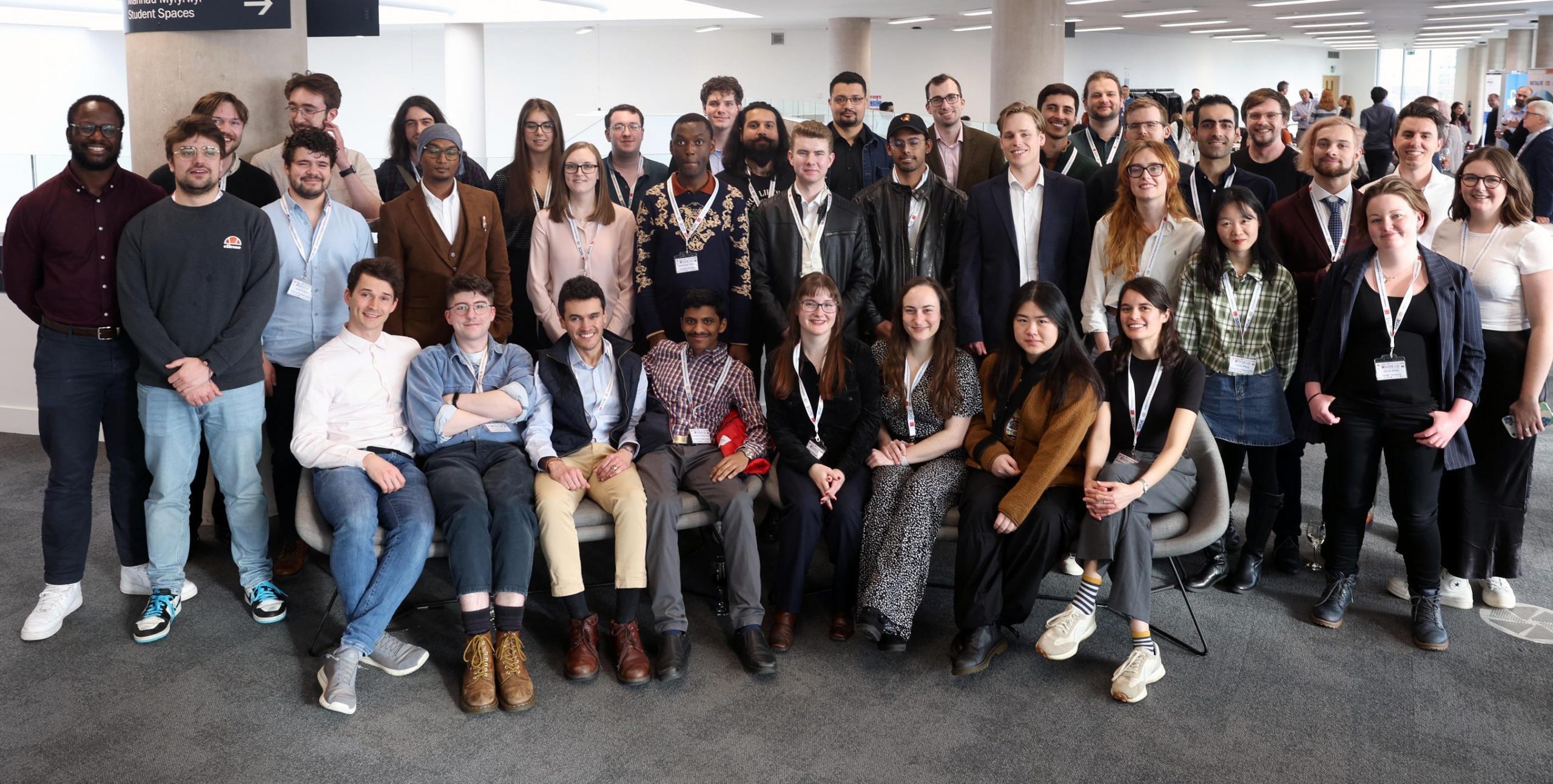
Why choose a PhD in Compound Semiconductor Manufacturing?
Compound Semiconductor (CS) materials are a Key Enabling Technology at the heart of
modern society, supporting our connected world, our health, our security and our environment.
They are core to the development of, for example, the 6G network, sensors for autonomous vehicles, the internet of things (IOT), future displays, satellite communications, photovoltaics, power electronics for the next generation of electric vehicles and new imaging techniques.
Our CDT will provide the step change in CS manufacturing necessary to realise the new technologies, with a focus on embedding energy and resource efficiency into these manufacturing processes. Our vision is to ensure the UK’s research strength in CS is realised in energy efficient and manufacturable approaches so that the UK can be at the forefront of the vast new opportunities that CSs provide.
The government’s National semiconductor strategy – GOV.UK (www.gov.uk ), published in May 2023, outlines why a strong CS sector in the UK is so important to our technological growth, supply chains and national security.
The next generation of these technologies can only be achieved with a step change in CS manufacturing. The future growth for high-value jobs within the CS Cluster core partners is forecasted to be high with thousands of additional jobs likely to be created. Employers recognise the future requirement for staff educated to PhD level and our graduates are in demand by both industry and academia.
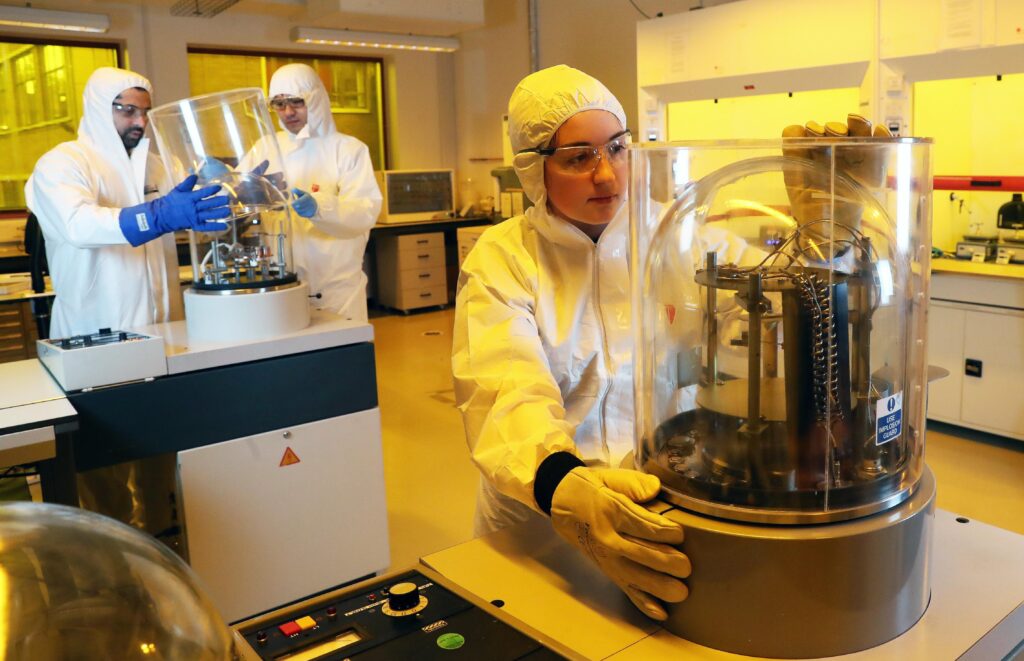
Why choose a PhD in an EPSRC Centre for Doctoral Training?
CDTs have developed over the last 20 years to create a community of researchers focussed on particular challenges of strategic importance. They have been supported by the Engineering and Physical Sciences Research Council (EPSRC) because they create a strong cohort of students who develop skills beyond the specialist topic of their PhD, and develop networks across universities and beyond.
They provide a supportive and exciting environment, creating new working cultures and forging lasting links with industry. CDTs offer many benefits over ‘stand-alone’ PhDs, highlighted in this article by FindaPhD, one of the most significant of which is targeted training:
“In addition to monetary support, a CDT will also provide research training throughout your PhD. This can vary between training centres, but it will teach technical and transferable skills relevant for a doctoral researcher. Training in core professional skills – project management, teaching, writing and presenting – aims to enhance employability and is useful for future careers in both academic and industry.
The training provided by a CDT studentship may have several advantages over a traditional PhD programme. The collaborative nature of a CDT means there may also be emphasis on multi-disciplinary or inter-disciplinary knowledge, training and research. Due to CDTs being dedicated for specific research output, the training will be tailored to address the skills needed at the doctoral level. In a CDT, students may work more closely with industry, and therefore develop in industry-relevant skills. The cohort-based approach may also mean that there should be shared training and development”
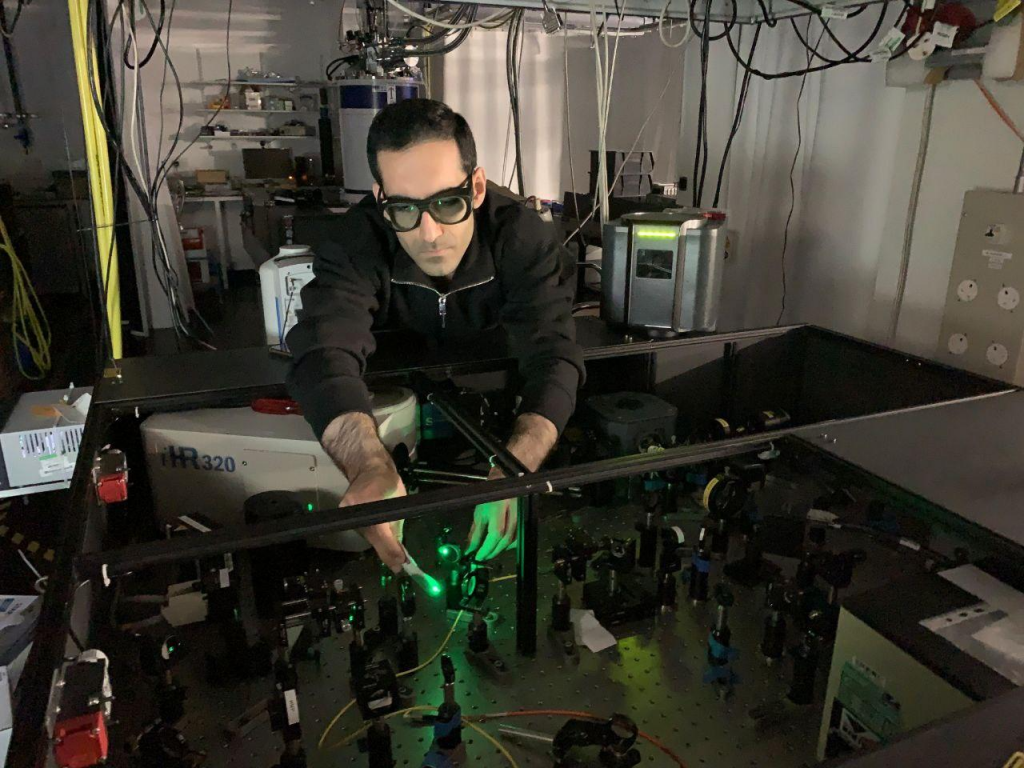
Why choose EPSRC CDT for Compound Semiconductor Manufacturing?
The CSM CDT undertakes a multi-institutional, cohort-based training approach, with strong industrial partnerships, to support the development of a highly skilled research workforce with expertise in compound semiconductor manufacturing. We do this in a holistic manner, rather than have isolated individual students focusing only in specialised aspects of CS research, which is typical of a ‘stand-alone’ PhD.
We provide training that maintains scholarly depth in a specialism , but also provides an understanding of the issues throughout the entire manufacturing process, to fully equip students with transferable skills and supply a future-ready breadth of practical skills.
We deliver appropriate hands-on experimental and theoretical training related to CS device and system level design. We implement and nurture in our students the capacity to develop innovative alternatives to improve current capabilities in a range of CS enabled sectors, like Energy and Healthcare Technology. This approach contributes to more rounded individuals, ready for careers in either academia or industry.
Engagement with industry is a core part of the CDT. We work with partners from across the compound semiconductor supply chain to ensure that training and research remain relevant to current and future manufacturing challenges.
Industry partners may:
- Contribute to the design and direction of research projects
- Co‑supervise PhD students
- Provide training, placements, or access to facilities
- Engage with early‑stage research and emerging talent
This collaboration benefits students by exposing them to industrial research environments and benefits partners through access to doctoral‑level expertise and research.
Our CDT is embedded in a vibrant and well-funded cluster dedicated to CS technologies, building on existing academic and industrial capability and manufacturing excellence. We are drawing on the resources and expertise in the cluster, giving you access to the huge range of expertise and opportunities to develop a challenging research project, build a network and contextualise your work, for example:
- Institute for Compound Semiconductors at Cardiff University with a new £80M Translational Research Facility to house more than 100 researchers.
- The Compound Semiconductor Centre Ltd., a joint venture between Cardiff University and IQE Plc with 75 staff dedicated to CS materials research and manufacturing in Cardiff. The CSC typically concentrates on delivering opportunities that are 1-3 years from market exploitation through well-defined delivery paths made possible by effective collaboration with our project partners.
- The Catapult in Compound Semiconductor Applications, which has over 80 highly skilled applications engineering specialists
- The EPSRC funded Future Compound Semiconductor Manufacturing Hub, led by CU in collaboration with Cambridge, Manchester, Sheffield and UCL to address the challenges of manufacturing scale-up of novel CS materials technology.
- The CS Foundry is the first flagship project of the Cardiff Region City Deal, to house the world’s largest epi-foundry operated by IQE Plc and the HQ of the CSA Catapult. This £38M public investment has unlocked £375M private investment and is currently in the process of scaling to 2000 jobs in the wider supply chain.
- Excellent research facilities and leading researchers at all four University partners.
Find out more about compound semiconductors in this Cardiff University CPD Virtual Summer School ‘Inside the Mysterious World of Compound Semiconductors’ with Chris Meadows of CS Connected.